• Well, we all know Euclid´s “Elements” and weird problems such as prime counting functions (see Terence Tao´s blog for this). A simple addendum to Euclid´s ideas would be to say that instead of the normal axioms (0 dimension = point, 1 dimension = line etc…) a monomial or polynomial already encodes such properties.

    Instead of writing “Elements”, wouldn´t a “Polynomials” book be more accurate nowadays?

    I give three immediate examples: Einstein´s general relativity would be an harmonic oscillator of a “group” of polynomials (very witten-esque isn´t it!!!!).

    Jacob Lurie´s attempt of introducing path integrals (through his weird language) between algebra (weird since any first year calculus student knows algebra calculus) would simply be the least action of this “group”.

    Finally, I´m talking about “groups” here but what is a group? I think probably a type III von Neumann algebra coupled with some sort of flow (be it modular or not; see Tomita-Takesaki lecutres on Springer) would suffice to define these polynomials.

    Cheers

  • If the Universe could be observed as a generalized wavefunction $psi$, perpetually collapsing unto physical properties, what axioms would hold for a coherent picture of reality? A generalized Hilbert space, following von Neumann algebras? Not very pretty. Cauchy´s integral formula and theorems are prettier:

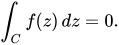
    Essentially, it says that if {\displaystyle f(z)} is holomorphic in a simply connected domain Ω, then for any simply closed contour {\displaystyle C} in Ω, that contour integral is zero.

    {\displaystyle \int _{C}f(z)\,dz=0.} (took this directly from Wikipedia: https://en.wikipedia.org/wiki/Cauchy%27s_integral_theorem). Now, Let U be an open subset of the complex plane C, and suppose the closed disk D defined as

    {\displaystyle D={\bigl \{}z:|z-z_{0}|\leq r{\bigr \}}}

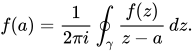
    is completely contained in U. Let f : U → C be a holomorphic function, and let γ be the circle, oriented counterclockwise, forming the boundary of D. Then for every a in the interior of D,

    {\displaystyle f(a)={\frac {1}{2\pi i}}\oint _{\gamma }{\frac {f(z)}{z-a}}\,dz.\,}

    (https://en.wikipedia.org/wiki/Cauchy%27s_integral_formula). If f(z) = $psi$, the information paradox would literally like finding a needle on a haystack, only the needle would be a photon collapsing into the big haystack of an event horizon.

  • Welcome to WordPress! This is your first post. Edit or delete it to take the first step in your blogging journey.